
Buying Guide
Refinishing Hardwood Floors in Central North Carolina
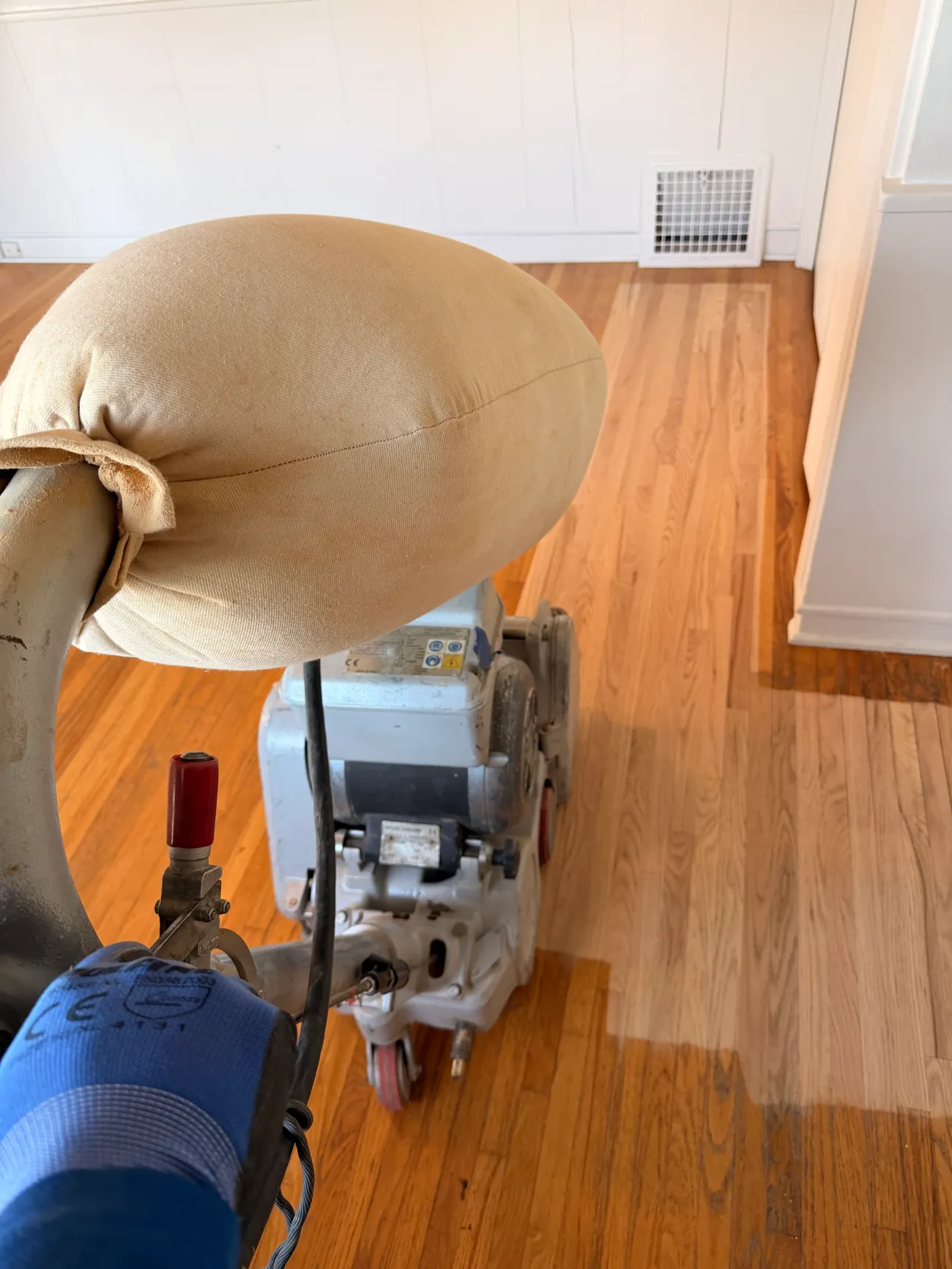
A tired hardwood floor is one of the few things in a house that can be made new again rather than replaced. Refinishing removes the old finish and a thin layer of wood, taking the scratches and stains with it, and rebuilds the protective surface on top. It costs considerably less than a new floor and it keeps the character that made the floor worth having.
Refinish, or just recoat?
These are different jobs and the difference is money. A full refinish sands into the wood. A screen and recoat abrades only the existing finish and lays a fresh coat on top, without touching the wood at all.
There is a simple test you can do yourself. Run a fingernail across one of the marks. If it catches, the damage is into the wood and needs sanding. If it does not, the damage is in the finish and a recoat will handle it for a fraction of the cost and a fraction of the disruption.
We would rather sell you the recoat where a recoat is the right answer, and we will tell you which one you are looking at.
What a full refinish involves
The floor is sanded in stages, working from a coarse grit that removes the old finish and levels the surface through to fine grits that leave it smooth enough to accept a finish evenly. Edges and corners are done separately because a drum sander cannot reach them.
Then colour, if you want it, and then the protective coats. The number of coats is worth asking about when comparing quotes, because it is the line that quietly differs between them and it directly determines how long the floor lasts before it needs doing again.
How NC humidity changes the schedule
This is the part that surprises people. Finish curing is affected by humidity, and central North Carolina summers are humid enough to slow it down meaningfully. A finish that is dry to touch is not the same as a finish that is cured.
That means three separate dates matter, not one: when you can walk on it, when furniture can come back, and when rugs can go down. Putting a rug over a finish that has not finished curing traps solvent underneath and can mark it permanently. We give you all three dates rather than a single completion day.
- ✓Walking on it: soonest, usually in socks.
- ✓Furniture back: later, and slid on felt rather than dragged.
- ✓Rugs down: last, and the one most often rushed.
Dust, and what to expect
Sanding produces a lot of fine dust and how a company handles it is the fastest read on how they work. Containment and extraction at the machine keeps it out of your cabinets, your ductwork and the tops of your doorframes.
Ask about it directly when you get quotes. An answer that amounts to sweeping up afterwards is not the same as capturing it at the source.
What sanding uncovers
Taking the old finish off reveals what was hidden underneath it. Old repairs done badly, boards cupped from a leak nobody mentioned, filler that had been covering gaps.
None of that is unusual in an older home and all of it is better found at the quoting stage than mid-job. We look before we price, and we write a contingency into the quote rather than presenting a flat number that assumes everything underneath is perfect.
How many times can a floor be refinished?
Solid hardwood has a real wear layer above the tongue and can generally take several refinishes across its life. That is the whole argument for solid wood as a long-term floor.
Engineered is different and depends entirely on the thickness of its real-wood top layer. Some engineered floors sand beautifully; others have a veneer too thin to touch, and sanding through it ruins the board. We check before we start rather than assuming, because that mistake cannot be undone.
Ready To Plan Your Floors?
Get a free in-home or in-store consultation with our Angier team. We match the right product to every room and back it with a 100% satisfaction guarantee.
Get My Free Estimate