
Buying Guide
Tile Patterns and Layouts: How to Choose One That Suits the Room
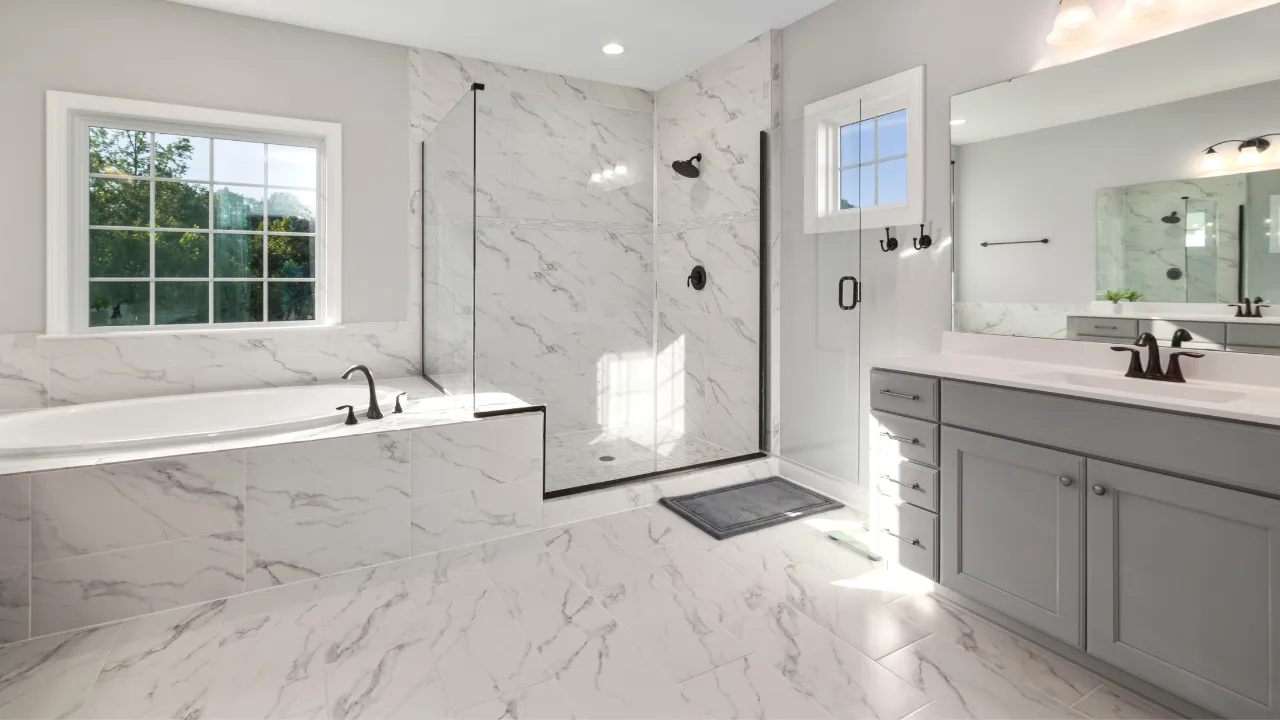
People choose a tile and then ask how it should be laid, which is backwards more often than not. The layout changes how large the room feels, how much the job costs, how much tile you need to buy, and how forgiving the finished floor is about a wall that is not quite square. In a lot of rooms it makes more difference than the tile itself. Here are the layouts we actually install, what each one does, and which rooms they belong in.
Straight lay, or grid
Tiles aligned in rows and columns, grout lines running straight in both directions. The simplest layout, the least waste, and the least labor.
It is also the least forgiving. A grid draws a set of perfectly straight lines across the room, and if the walls are not square to each other, the grid announces it. In an older house that is a real consideration; in newer construction around Holly Springs and Willow Spring it is usually fine.
Best in: large-format tile, contemporary rooms, and anywhere you want the tile to be quiet rather than to be the feature.
Offset, brick and one-third
Each row shifted relative to the one above it. A half offset — the classic brick pattern — shifts by 50 percent. A one-third offset shifts by a third and is the one to use with long plank-format tile.
Offsets hide a lot. Because there is no continuous grout line running the length of the room, small variations in wall alignment and tile size disappear into the pattern instead of being lined up for inspection.
One warning worth knowing before you commit: with long, large-format tile a half offset can produce lippage, where the middle of one tile sits proud of the corner of its neighbor because the tile has a slight bow. It is a well-known effect and it is why a one-third offset is the standard recommendation for plank tile rather than a half.
Best in: plank-format tile, bathrooms, kitchens, and any room where the walls are not to be trusted.
Diagonal
A grid rotated 45 degrees to the walls. The oldest trick in the trade for making a narrow room look wider, because the eye follows the long diagonal rather than the short wall.
It costs more, for two reasons that are both real: every tile at the perimeter is a cut, and the waste factor goes up noticeably compared with a straight lay. It also takes longer to set out, because the starting line is not a wall.
Best in: narrow hallways, small bathrooms, and square rooms that need some movement.
Herringbone
Rectangular tiles laid at 90 degrees to each other in a zigzag. The most-requested pattern of the last few years and, done well, the best-looking floor on this list.
It is genuinely more work. Every perimeter tile is an angled cut, the setting-out has to be exact or the pattern drifts visibly across the room, and waste runs well above a straight lay. Budget for it as a pattern rather than assuming it is the same job with the tiles turned.
A double herringbone, using pairs of tiles, reads as more traditional and covers ground faster.
Best in: entryways, powder rooms and kitchens — rooms where the floor is meant to be noticed. Less good across a very large open plan, where it can become busy.
Chevron
Often confused with herringbone and not the same thing. Chevron uses tiles cut at an angle on their ends so they meet in a continuous V with an unbroken line running down the middle. Herringbone uses square-ended tiles that overlap.
Chevron is the more formal of the two and the more expensive, because it needs purpose-made angled tile or a lot of cutting. The payoff is a floor with a strong directional line, which can lengthen a room dramatically.
Best in: entries and hallways where you want a strong sense of direction.
Basketweave, hexagon and mosaic
Basketweave — pairs of rectangles alternating direction, often with a small accent square — is a traditional pattern that suits period bathrooms and mudrooms.
Hexagon has become a bathroom standard, and small hex mosaic has a practical advantage in a shower floor: all those grout lines give grip, and the small format follows the slope to the drain without lippage.
Mosaic sheets are the practical answer anywhere the floor has to bend — shower pans, curbs, and niches.
Best in: bathrooms, showers, mudrooms and any room where the pattern is doing a job as well as a look.
What each pattern does to the price
Two lines move, and they move together. Waste goes up as the pattern gets more complex, because more perimeter tiles are cut and more cuts are unusable. Labor goes up because setting out is slower and there are more cuts to make.
Roughly in order, from least to most: straight lay, offset, diagonal, herringbone, chevron. A herringbone floor is not a straight lay with the tiles turned — it is a different job with a different price, and any quote that treats them the same is one to ask about.
One universal rule regardless of layout: buy the extra box and keep it. Tile runs are produced in batches with slight shade variation, and a discontinued tile is not replaceable at all. The box in the garage is what makes a future repair invisible.
Grout is half of the pattern
It is easy to spend a long time choosing tile and thirty seconds choosing grout, and the grout color decides whether the pattern reads loudly or quietly.
Matched grout — close to the tile color — makes the floor read as one surface and makes a room feel larger. It is what we would use for a large-format straight lay you want to be calm.
Contrasting grout draws the pattern in outline. On a herringbone or a hex it is what makes the pattern visible at all, and it is a deliberate feature rather than an accident.
Mid-tone grays hide dirt better than either white or very dark, which matters most in an entry or a mudroom.
Grout width matters too: a rectified tile can be laid with a very narrow joint, while a tile with more size variation needs a wider one to absorb it.
Sorting it out on the floor
The single most useful thing you can do before committing is to lay a few loose tiles out on the floor in the pattern you are considering, in the room, in daylight. Patterns look completely different at floor scale than they do on a sample board.
We will do that with you. APW has been fitting tile in Angier, Willow Spring, Holly Springs, Apex and across central North Carolina since 1973, and our installers are background-checked and trained — which matters more with a pattern than with anything else on a tile job. See tile flooring for what we install, or book a free estimate and we will price the layout properly rather than folding it into a square-foot rate.
Ready To Plan Your Floors?
Get a free in-home or in-store consultation with our Angier team. We match the right product to every room and back it with a 100% satisfaction guarantee.
Get My Free Estimate