
Comparison
Refinish or Replace? How to Tell What Your Hardwood Floor Needs
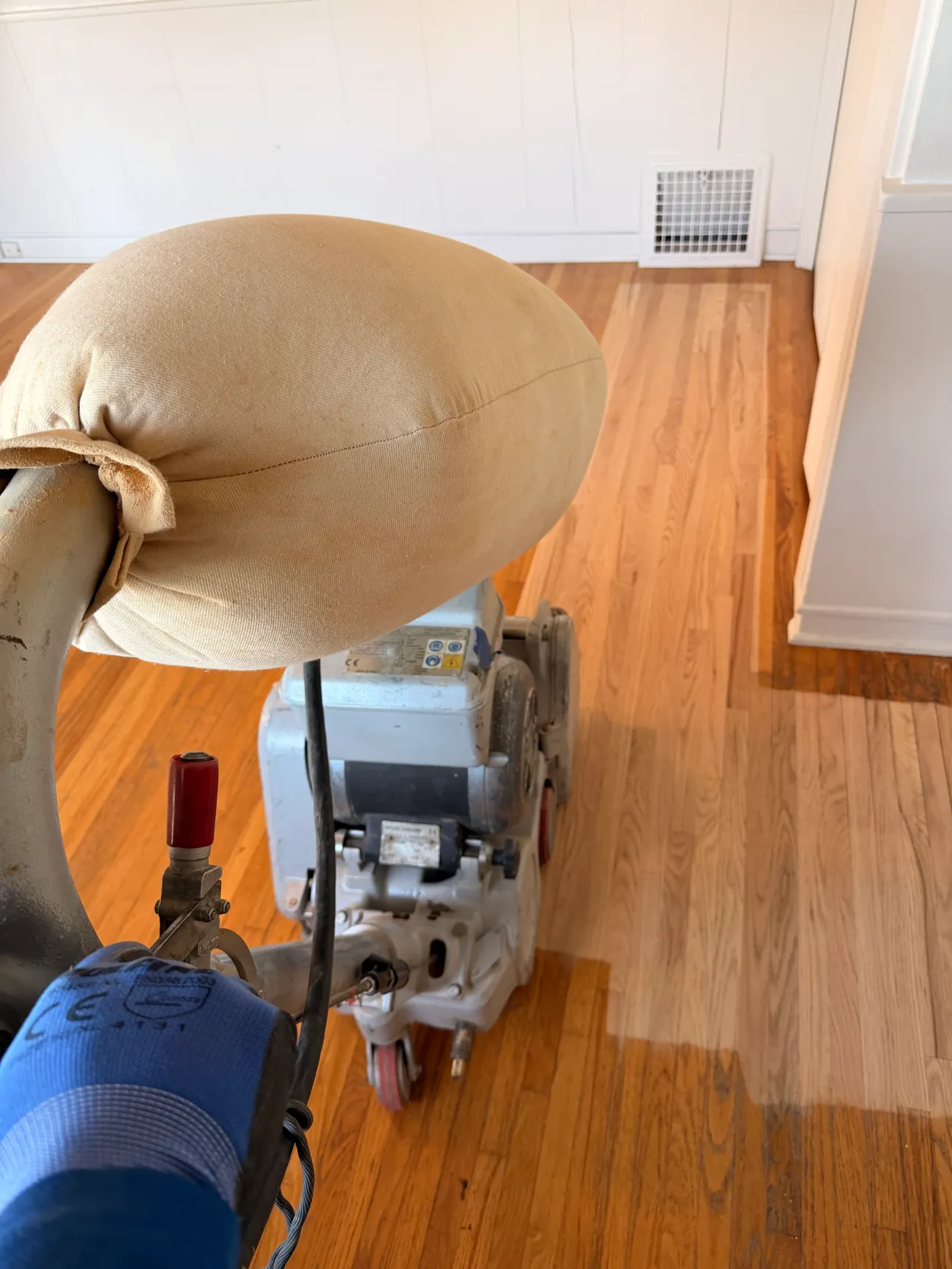
A tired hardwood floor gets replaced far more often than it needs to be, usually because nobody told the homeowner that refinishing was on the table. Refinishing costs a fraction of a new floor, keeps the wood that is already there — which in an older central North Carolina house is often better material than anything you can buy today — and takes a few days rather than a project. But it is not always possible, and there is a real line between the two. Here is how we work out which side of it a floor is on.
What refinishing actually is
Sanding a hardwood floor down past the old finish and any surface damage, then applying stain if you want it and several coats of new finish. You end up with the same boards and a new surface.
There is also a lighter version, a screen and recoat — the existing finish is abraded rather than removed, and a fresh coat goes over it. It costs much less, takes a day or two, and it is the right answer surprisingly often. It only works while the finish is still intact; once the wood itself has been reached, it is a full sand.
Both are covered on our hardwood refinishing page.
Five checks that decide it
1. Is there enough wood left? This is the one that rules refinishing out. A solid hardwood floor can be sanded several times over its life; each sanding takes a little wood. Look at a floor register vent or a doorway threshold — anywhere you can see the board in cross-section. If the surface is close to the top of the tongue and groove, there is not enough left to sand.
2. Is it solid or engineered? Solid hardwood can be sanded many times. Engineered wood has a real wood veneer over a plywood core, and its wear layer might allow one sanding, or none at all, depending on thickness. Getting this wrong ruins the floor, which is a good reason not to hand it to whoever is cheapest.
3. Is the damage on the surface or through it? Scratches, dullness, pet marks, sun-faded patches and old finish are all surface problems, and every one of them sands out. Deep gouges, water staining that has gone gray or black, and boards that are cupped or crowned are through-the-surface problems, and they need repair before any sanding.
4. Is the subfloor sound? A floor that flexes, bounces or squeaks badly has a problem underneath it, and sanding the top does not touch that. Sometimes the right sequence is subfloor work first and refinishing after — see subfloor repair.
5. Do you actually want this floor? The honest one. Refinishing gives you the same boards in the same width, species and layout. You can change the color completely and the sheen entirely, but a 2¼-inch red oak strip floor refinished is still a 2¼-inch red oak strip floor. If what you want is wide plank, refinishing cannot get you there.
When refinishing is clearly the right call
It is the answer more often than people assume, and these are the cases where it is not close.
The floor is solid hardwood with plenty of thickness left and the problems are cosmetic. Scratched, dull, dated color, worn traffic lanes — all of that is exactly what sanding is for.
The house is older and the boards are better than what money buys now. A lot of homes around Angier, Dunn and Lillington have old-growth oak or heart pine in them. That material is not available in a store, and covering it is a genuine loss.
You want a different color. Going lighter, going darker, or moving from a yellowed old finish to a natural modern one — all achievable on the existing boards, and it changes a room as completely as a new floor does.
The budget matters and the floor is sound. Refinishing is a fraction of the installed cost of new hardwood, and there is no tear-out or disposal in it.
When replacing is the right call
The wood is too thin to sand, or it is engineered with a veneer too thin to take it.
Water damage over a large area. Isolated damaged boards can be woven in and refinished with the rest; a whole room that has cupped and stayed cupped is usually replacement, and the moisture source has to be found first either way.
Structural or subfloor failure severe enough that the floor has to come up anyway. If the floor is being lifted for other reasons, refinishing it afterwards is often not the cheaper path.
You are changing the floor's character, not its condition. Different species, wider planks, a different direction, or moving the hardwood to a different set of rooms.
The room is wrong for hardwood. Bathrooms, laundries and anywhere below grade are not hardwood rooms in this climate. If a previous owner put wood somewhere it does not belong, replacing it with something waterproof is the fix rather than refinishing it and waiting. Our comparison of hardwood versus luxury vinyl in NC humidity covers that trade honestly.
The middle answer people miss
It does not have to be all one or all the other, and the mixed approach is often the best value in the house.
Refinish the good rooms and replace the bad ones. Common in houses where the living areas are fine and one room took water.
Weave in new boards and refinish everything together. Where damage is confined to a section, new boards can be laced into the existing floor and the whole floor sanded and finished as one. Done properly, the repair disappears. This is skilled work and it is worth asking whether whoever is quoting has done it.
Screen and recoat now, full refinish later. If the finish is worn but the wood is untouched, a recoat buys several years for a fraction of the cost and leaves every option open.
What our climate adds to the decision
Central North Carolina humidity swings a long way between a wet summer and a dry heated winter, and hardwood moves with it. Two practical consequences.
First, do not refinish a cupped floor until it has dried out and flattened. Sanding a floor that is still holding moisture gives you a floor that goes concave when it finally dries, and that is not recoverable without sanding again.
Second, timing matters. Finish cures more slowly in high humidity, which stretches the days between coats and the days before furniture can go back. It is not a reason to avoid summer, but it is a reason to expect the schedule to be a little longer than a quote from a drier state would suggest. Our post on how long a flooring project actually takes covers the rest of the timeline.
Get somebody to look at it before you decide
Most of this is decidable in twenty minutes with the floor in front of you — thickness at a vent, solid or engineered, whether damage is surface or structural. It is not decidable from a photograph, and it is the single most common thing we are asked to settle.
APW has been working on hardwood in Angier and across central North Carolina since 1973. We will tell you when a floor can be saved, and we will tell you when it cannot — including when a screen and recoat is all it needs. Book a free estimate, or read our guide to hardwood floor refinishing for what the job itself involves.
Ready To Plan Your Floors?
Get a free in-home or in-store consultation with our Angier team. We match the right product to every room and back it with a 100% satisfaction guarantee.
Get My Free Estimate